

There Is No Such Thing as “Away” When It Comes to Clothing Waste
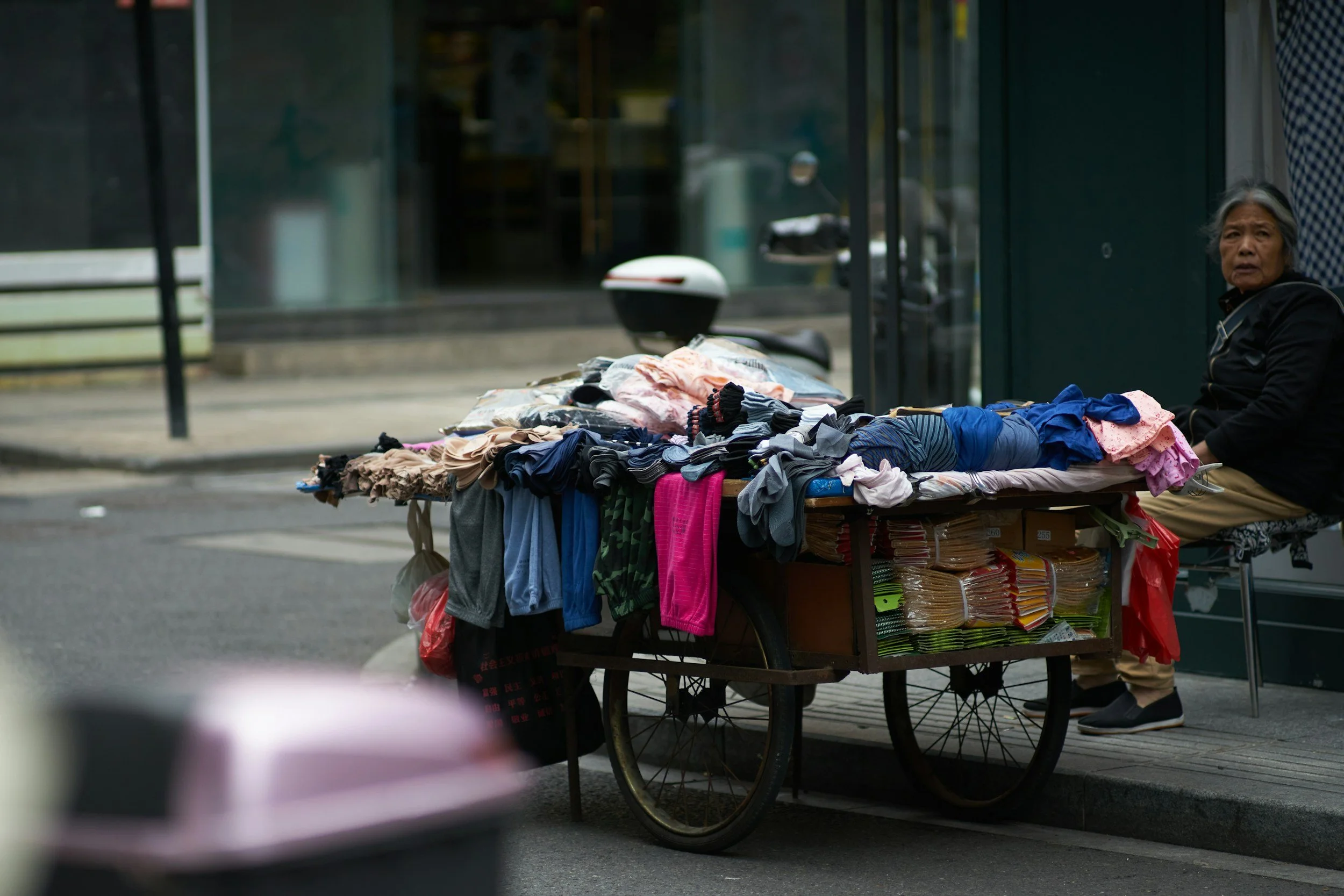
What actually happens after we clean out our closets
For most of my life, I thought donating clothes was basically the end of the story.
You clean out your closet, make a bag of the things you don't want anymore, drop it off at a donation center and drive home feeling pretty good about yourself.
Closet cleaner. Clothes donated. Problem solved.
Then I saw photos of mountains of discarded clothing in Chile's Atacama Desert.
That was one of the moments that eventually pushed me deeper into sustainable fashion because it made something painfully obvious that I had somehow never really considered before.
There is no such thing as “away.”
Our clothes don't disappear when they leave our closets. They just become someone else's responsibility, and where they go from there is a much bigger, messier system than I realized.
Your donation bag has a second life
I want to start here because I am absolutely not telling you to stop donating your clothes.
Donation can be a great way to keep clothing in use, especially when you're giving good, wearable pieces to organizations that can actually use or resell them.
The part I had wrong was assuming that donating something automatically meant another person would wear it.
There is simply too much clothing moving through the system for that to happen.
According to reporting from The Washington Post, about 30 percent of the total weight of clothing donated to Goodwill is sold locally through its stores, outlets or online.
The rest doesn't simply vanish.
Depending on the garment, condition and organization, clothing that isn't sold may move through other channels, including textile sorting, recycling or rag markets, overseas resale, and eventually disposal.
That doesn't make donation bad.
It makes donation a middle step, not an ending.
And once I started thinking about it that way, I became much more interested in what happens before the donation bag.
We have a volume problem
This is where the numbers start getting a little bananas.
According to Textile Exchange, global fiber production reached 124 million tonnes in 2023 and could reach 160 million tonnes by 2030 if current trends continue.
Meanwhile, less than 1 percent of textiles are recycled back into new clothing.
So while brands are talking about recycling programs and circularity, we're still making an enormous amount of new material and recycling very little of it back into clothes.
The United States has its own version of the problem. A 2024 report from the U.S. Government Accountability Office found that textile waste has increased by more than 50 percent since 2000, while U.S. textile and apparel imports increased 182 percent between 2000 and 2023.
Basically, we have gotten incredibly good at putting clothes into the system without building nearly enough ways to deal with what comes out of it.
Which brings us back to away.

Sometimes “away” is another country
When clothing can't be sold locally, some of it enters the global secondhand market and gets shipped overseas.
There is an important distinction here because exported secondhand clothing isn't automatically waste. There are real secondhand economies around the world, and wearable clothing can absolutely continue its life somewhere else.
The problem comes when the volume and quality of clothing entering those systems exceed what can actually be reused or sold.
Chile is one very visible example.
According to The Guardian, Chile imports around 123,000 tonnes of used clothing each year, with large amounts of unsold clothing eventually ending up discarded in and around the Atacama Desert.
Those were the images that got me.
Thousands and thousands of pieces of clothing sitting in a desert because there was nowhere else for them to go.
Something about seeing clothing physically piled up made the idea of waste impossible to keep abstract.
That cute top didn't disappear.
It went somewhere.
Recycling isn't a magic eraser either
I wish this were the part where I told you we could simply recycle all of it.
Unfortunately, clothes are complicated little creatures.
Look at the tag inside something you’re wearing and you might find cotton blended with polyester and a little elastane. Those blends can make a garment stretchy, comfortable or durable, but they can also make textile-to-textile recycling much harder.
Separating multiple fibers from one another at scale isn't simple, which is one reason less than 1 percent of textiles currently make their way back into new clothing.
Recycling absolutely has a role in the future of fashion, and I am very excited about where some of that technology could go.
I just don't think we can use the promise of future recycling as permission to keep producing and consuming clothing at our current pace.
There is a much less technologically exciting solution available to us right now.
Keep the clothes we already made in use longer.
Your old clothes have options
This is the part of sustainable fashion that I find much more fun because keeping something in use doesn't have to mean reluctantly wearing the same shirt until it disintegrates off your body.
Clothes can change.
A dress you never wear might make an incredible top. The jeans with the stain can be dyed. A hole can be patched. Something you stopped styling three years ago might suddenly work differently with the wardrobe you have now.
You can also swap things with friends, sell them, shop secondhand when you need something different, or hand something down to a person who actually wants it.
This is a huge part of what we're trying to do at Rotate.
Our [Repurpose Parties] give you a place to turn clothes you stopped wearing into something you're excited about again. The [DIY upcycling kits] are there when you want to experiment at home, and shopping [Rotate secondhand] gives an existing garment another chance before we need to make something new.
None of those things individually “solve” fashion waste.
That's not the point.
They give us more options between I don't want this anymore and get rid of it.
And I think we desperately need more of those options.
Keep it in rotation
The more I learn about clothing waste, the less interested I am in trying to be the perfect sustainable shopper.
I am much more interested in becoming a person who pauses before assuming I'm finished with something.
Maybe it needs a repair. Maybe I can alter it. Maybe someone else genuinely wants it. Maybe I need to accept that I bought something for my imaginary life again and learn from that before I make the next purchase.
Sometimes donation will still be the best option, and eventually every piece of clothing will reach the end of its useful life.
The goal isn't to keep every T-shirt on Earth forever.
It's to stop treating the moment we are finished with something as the moment that thing stops existing.
Because the trash can isn't away.
The donation bin isn't away.
Another country definitely isn't away.
Away is always somewhere.
The more time we give our clothes before they get there, the better.